Valentine.gr/The Greek Flowers Portal
 

flaglogo-gr.bmp (910 bytes)  

Unitedkingdom_sm.gif (528 bytes)  

 
Search WWW Search Valentine.gr

Welcome To The Greek Flowers Portal

Home   Info   Contact


Join Valentine mailing list!
Enter your email address below,
then click the 'Join List' button:


ADVERTISEMENT...


  LINK OF THE MONTH

Valentine.gr  

September 2007

Did you know that Pittosporum species contains toxic substances, the saponins which are used as soap or as a bird repellent?

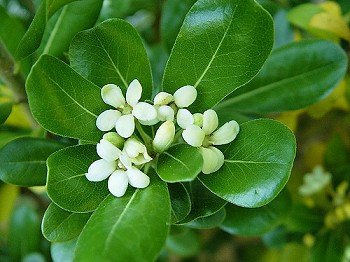
 Japanese pittosporum - Pittosporum tobira 

Pittosporum - Pittosporum spp.

Pittosporum is a genus of about 200 species of flowering plants in the family Pittosporaceae. The genus is probably Gondwanan in origin; its present range extends from Australasia, Oceania, eastern Asia and some parts of Africa.

The species are trees and shrubs growing to 2-30 m tall. The leaves are spirally arranged or whorled, simple, with a waved margin. The flowers are produced singly or in umbels or corymbs, each flower with five sepals and five petals; they are often sweetly scented. The fruit is a woody seed capsule, which bursts on ripening to release the numerous seeds. The seeds are coated with a sticky resinous substance. The genus is named after their sticky seeds, from the Greek meaning 'pitch-seed'.

Pittosporum undulatum (Sweet Pittosporum) from eastern Australia is an invasive weed in some areas. Karo (Pittosporum crassifolium) is a small wild tree or shrub native to New Zealand. Mature trees grow to about 5m in height. Karo has dense dark gray-green leathery foliage and small red-purple flowers. Pittosporum tenuifolium and P. eugenioides, both from New Zealand, and Pittosporum tobira from southern Japan are widely cultivated as ornamental plants in warm areas.

Pittosporum tobira is as beautiful broadleafed evergreen shrub or small tree can reach up to 15 ft (4.6 m) in height and approximately the same in width. In general the Japanese pittosporum grows taller in the shade while those grown in full sun are more compact. In both situations the plant assumes an upright round-headed form with branches radiating out from around the stems. This pittosporum is native to China and Japan, but is used as an ornamental in milder climates throughout the world.

Pittosporum tobira can be grown as an outside plant or as a containerized shrub. Pittosporum plants displays bright green leaves year and grows best in shady areas of low light. The flowers are small, white, and very fragrant. Florists use stems and leaves as fillers in floral arrangements.

Pittosporum shrubs are not fast growing, but eventually can form an excellent privacy hedge to block out automobile noise and fume emissions. Because Pittosporum tobira shrubs are salt water tolerant, these shrubs are popularly used in landscaping at coastal areas. Large specimens of Pittosporum tobira are used as evergreen small trees, that subtly present an exotic, tropical appearance. Pittosporium tobira "Variegata" has variegated white and light green leaves with fragrant white flowers, blooming in the summer. The variegated leaf form of Pittosporum tobira is not burned by strong sunlight, like most variegated shrubs.

Pittosporum species contains toxic substances, the saponins. Saponins are found in many foods, such as some beans, and although they are fairly toxic to people they are poorly absorbed by the body and most pass straight through without any problem. They are also broken down if the food is thoroughly cooked for a long time. Saponins are much more toxic to some creatures, such as fish. These have the potential to be used as soap or as a bird repellent. Since they are very bitter they can be sprayed over plants that you do not want the birds to eat. The saponins are easily removed by washing or the next rain shower. 


Source:

http://en.wikipedia.org/wiki/Pittosporum
http://www.floridata.com/ref/P/pitt.cfm

http://www.ezinearticles.com/

http://www.pfaf.org/database/plants.php?Pittosporum+phillyreoides

 

  LINK OF THE MONTH


Blue Poppy - Meconopsis
Cannonball Tree - Couroupita guianensis
Tamarillo - Cyphomandra betacea
Goji - Wolfberry - Lycium barbarum
Vanilla - Vanilla Planifolia
Stevia - Stevia rebaudiana
Pachypodium
Physalis
Ceropegia
Sturt pea - Swainsona formosa
Clematis
Grevillea
Jade vine - Strongylodon macrobotrys
Sansevieria - Snake Plant
Trochetia
Yareta - Azorella compacta
African tulip tree - Spathodea campanulata
Angel's Trumpets - Brugmansia
Achiote - Annato - Bixa orellana
Sausage Tree - Kigelia pinnata
Castor Oil Plant - Ricinus communis
Firewheel Tree - Stenocarpus sinuatus
Bat Flower - Tacca
Snake gourd - Trichosanthes cucumerina
Sedum
Hydnora - Hydnora africana
Pickerel Weed - Pontederia
Argan - Argania spinosa
Astilbe - False Goats Beard
Feijoa - Pineapple Guava - Acca sellowiana
Aquilegia - Columbine
Cassiope
Sweet Box - Sarcococca
Christmas Cactus - Schlumbergera
Foxtail Lily - Eremurus
Rue - Ruta graveolens
Pittosporum
Ylang-Ylang - Cananga odorata
Rose of Jericho - Anastatica hierochuntica
Gunnera
Waterlily - Nymphaea
Calico Flower - Aristolochia
Daylily - Hemerocallis
Contorted hazel - Corylus avellana Contorta
Torch Ginger - Etlingera elatior
Mistletoe - Viscum album
Devil´s claw - Harpagophytum procumbens
Teasel - Dipsacus
Pampas grass - Gynerium argenteum - Cortaderia Selloanna
Purple coneflower - Echinacea purpurea
Coral Tree - Erythrina crista-galli
Portulaca
Lobelia
Field Poppy - Papaver Rhoeas
Narcissus - Daffodil
Mimosa pudica - Sensitive Plant
Boxwood - Buxus sempervirens
Firethorn - Pyracantha
Star of Bethlehem - Ornithogalum
Cosmos
Muscari - Grape Hyacinth
Papyrus - Cyperus papyrus
Zinnia
Honeysuckle - Lonicera
Passiflora - Passion Flower
Calendula - Marigold
Lupine - Lupinus
Canna - Indian Shot
Witch Hazel - Hamamelis
Oak - Quercus
Brunsvigia - Candelabra Flower
Tree peony - Paeonia suffruticosa
Olive - Olea europaea
Cornflower - Centaurea cyanus
Desert rose - Adenium obesum
Oleander - Nerium Oleander
Abutilon
Sweet Pea - Lathyrus odoratus
Chaenomeles - Flowering Quince
Forsythia
Amaryllis - Hippeastrum
Butchers broom - Ruscus aculeatus
Bay Laurel - Laurus nobilis
Gloriosa
Bamboo
Gladiolus
Artichoke - Cynara scolymus
Clivia - Clivia Miniata
Dipladenia - Dipladenia sanderii
Date palm - Phoenix dactylifera
Peach - Prunus persica
Almond - Prunus amygdalus
Willow - Salix
Pomegranate - Punica granatum
Protea cynaroides
Colchicum autumnale
Bird of Paradise - Strelitzia reginae
Cardon - Pachycereus pringlei
Wolffia arrhiza
Puya raimondii
Fuchsia
Asphodelus - Asphodel
Primula - Primerose
Dicentra spectabilis - Bleeding Heart
Edelweiss - Leontopodium alpinum
Helleborus Niger - Christmas Rose
Zantedeschia - Calla Lily
Fritillaria imperialis - Crown imperial
Aster
Heliconia
Common Sunflower - Helianthus annuus
Bee Orchid - Orphys apifera
Convalaria majalis - Lily of the Valley - Muguet
Syringa Vurgaris - Lilac
Viola
Impantiens
Snowdrop - Galanthus
Poinsettia - Euphorbia pulcherrima
Dionaea muscipula
Banksia
Sea anemone
Amorrhophallus titanum
Rafflesia arnoldi


ADVERTISEMENT...


Valentine.gr/The Greek Flowers Portal
....

Home | Information | Advertise | Contact Us | Greek Version | English Version