|
|
Rose of
Jericho (Anastatica hierochuntica)
|
Rose of
Jericho - Anastatica hierochuntica
Rose of Jericho, common name for
several plants belonging to different families in the plant kingdom. Two of them
are native to Asia Minor. One, an annual desert plant (Anastatica hierochuntica) of the family Cruciferae
(mustard family). The other, Odontospermum pygmaeum, is native to the same region and also called rose of Jericho because of its similar
properties. It is a member of the family Asteraceae (aster family). Both families are classified in the division
Magnoliophyta, class Magnoliopsida. The Cruciferae is in the order Capparales, and the Asteraceae is in the order
Asterales.
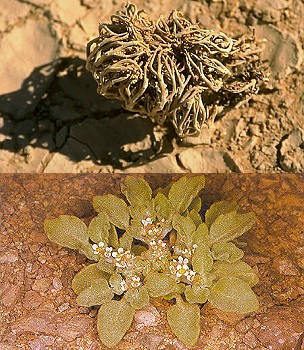
The most common Rose of Jericho, Resurrection plant, or Anastatica hierochuntica is a member of the family Brassicaceae
(formerly Cruciferae) and the only member of the genus Anastatica. It is a small grey herb that rarely grows above 15 cm
high. The plant bears minute, white flowers.
These plants are found in arid areas in the Negev and Sahara Desert, including parts of North Africa and regions of
Egypt, Israel, Iraq, Jordan, Pakistan, and Iran.
The Rose of Jericho practices an odd behaviour. After the rainy season, it dies and dries
up, curling its stems into a tight ball. This protects the seeds and prevents them from being dispersed
prematurely. The seeds of the plant are very hardy and can be dormant for years. When
wetted, the branches spread out and a fraction of the seeds are dispersed by raindrops hitting a
spoon-like appendix on the seeds. If rain allows, the dispersed seeds germinate. The process of curling up and opening is completely reversible and can be repeated many
times. Since the plant is annual, it dies after the wet season. However, many people believe that this is not
true. Indeed, only a few hundred species of flowering plants are real "resurrection
plants".
For example, the North American fern species Selaginella pilifera which is most commonly sold as the rose of Jericho can indeed be revived by a little
water. After wetting, the plant turns green, hence the name "resurrection
plant" is true for this plant species. Because of the potential age of the
plant, it has also taken the name
"dinosaur plant."
The american Rose of Jericho (Selaginella pilifera and Selaginella lepidophylla),
are native to Southwest United States and Central America.
These plants have the remarkable ability to survive in a curled up, dormant,
brown, dessicated state for years, and then open up and turn green with a bit of
water. After returning to a lovely green, they go dormant again when their water source is
removed, and can be revived again after dormancy. This cycle can be repeated for
years.
Selaginella
pilifera is a desert plant growing in the sands of Mexico. It is sold in Mexican markets for use as a
diuretic. It is also used in rituals of voodoo and Cuban santeria to generate
love, luck and money. When carried on a person it is said to absorb negative
energy.
The custom of Rose of Jericho, that flourishes every year just about Christmas
Eve, is famous in Christian reports of West Church.
The Virgin Mary blessed the eternal plant during the flight from Nazareth to
Egypt. These days the rose represents new beginnings, hope, and the resurrection of Jesus
Christ. Τhe Rose of Jericho is traditionally passed on to the next generation as an important part of one’s
inheritance.
In any case, the plant is often kept dormant in the home -- sometimes handed down through the generations -- and brought out at Christmas
time, along with the Christmas decorations, to blossom for a while and adorn the Christmas
table, and then close, all symbolizing the opening and closing of Mary's
womb.
The plant is usually sold in its dormant state. There is no need to plant it in
soil: simply place it in a bowl of water and it will open up and turn green within
hours. Change the water daily, and when ready to put it away, just let it dry out for a
week.
It can be kept green most of the year and used as an indoor plant, but that it should be allowed to go dormant
periodically.
Source:
http://en.wikipedia.org/wiki/Resurrection_plant
http://www.infoplease.com/ce6/sci/A0842428.html
http://www.fisheaters.com/roseofjericho.html