|
|
Purple coneflower
( Echinacea purpurea)
|
Purple
coneflower - Echinacea purpurea
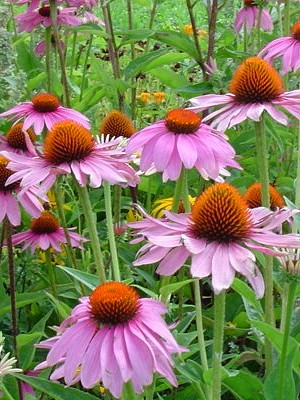
Purple coneflower (Echinacea purpurea) is a showy, clump forming herbaceous perennial that dies to the ground in winter and sprouts back in
spring. Established clumps can be up to 3 ft (0.6 m) in diameter and just as
tall. The dark green leaves are coarse and sandpapery, usually lance
shaped, and 3-8 in (7.6-20.3 cm) long. The daisylike flower heads, up to 3 in (7.5
cm) across, are very attractive with rose purple rays and large, cone-shaped purple brown
centers. Several cultivars are available to the gardener, including some with white ray
flowers.
Some varieties have pendulous or weeping
petals; some are more horizontal, but they all have a large seed cone that hints at the origin of the
name. Echinacea comes from the Greek echinos, meaning hedgehog.
Hardy in zones 3-8 and a native of North America, Echinacea purpurea, the Purple
Coneflower, is
a great perennial. The flowers attract butterflies and bees, while the seed heads are devoured by American
goldfinches. They form large mats that are very showy in the garden, where their purplish color contrasts nicely with the
yellow, orange and cool pinks of daylilies.
The foliage is not particularly attractive, but the height of the plant (1 m) means that it's best suited for the back of a natural border where the leaves will be
concealed. Dwarf varieties exist as well, such that it is possible to create a border with
short, medium and tall varieties.
Once established, the plants are tolerant of dry, gravelly or generally poor
soil, but they do require full sun. Given good soil, they will become quite
exuberant.
Like many native plant species, E. purpurea will readily self-seed in the garden, and will generally flower the second
year. Seed collectors note that seeds can be removed from the spiky seed heads by soaking in
water. Flower arrangers dry the urchin-like seed heads and use them with
everlastings. The dead heads can be removed to stimulate flowering, or left intact to attract
goldfinches.
While purple coneflower has been gaining popularity as a ornamental garden plant, its most interesting story comes from its history as an
herb. The Plains Indians of North America believed in its extraordinary benefits, using the roots to make a poultice for a number of wounds from insects and snakes to sore gums and
colds. During sweat lodge ceremonies, the water used to pour over the burning embers often included soaked Echinacea
roots. The resulting steam produced additional cleansing effects during the sweat
process.
The Early Plains settlers learned about the benefits of Echinacea, and many folk remedies were
developed. In the late 1800s, it was included in a cure-all that was bottled and patented by
Dr. H.C.F. Meyer and promoted as Meyer's Blood Purifier. However, the growing field of medical research did not take
Dr. Meyer's patented cure-all seriously.
It was only after a family business, Lloyd Brothers Pharmacists, produced its own Echinacea products that it gained widespread popularity in America as a treatment for colds and
infections. However, with the advent of modern antibiotics during the 1920s, Echinacea's usefulness as a healing herb
declined.
Not so in Europe. While cast off by the majority on its own soil, Echinacea gained recognition
overseas. In Germany, studies were devoted to understanding its healing
capabilities, which allowed the flower to gain approval from the Kommission E, which is similar to the Federal Drug Administration's
approval.
Today, it's widely used in Europe as treatment for a number of ailments ranging from infections and colds to boosting the immune
system.
Source:
http://www.floridata.com/ref/e/ech_pur.cfm
http://canada-gardens.com/2echinacea.html
http://www.findarticles.com/p/articles/
mi_m1082/is_n4_v42/ai_20912188