|
|
Honeysuckle
- Lonicera spp.
|
Honeysuckle (Lonicera
spp.)
Lonicera group (family
Caprifoliaceae) consists of about 180, evergreen and deciduous, woody climbers and
shrubs, commonly known as Honeysuckle. They are valued for their pretty flowers, which are sweetly
scented, and their decorative fruits, which birds find delectable. The climbing Honeysuckles are suitable for growing over a
trellis, arch, or pergola, while the shrubby kind are great for growing in borders and rock
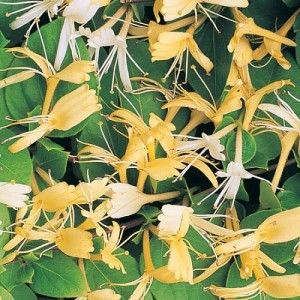
gardens, and as hedges. Their trumpet-shaped flowers are borne from late winter or early spring to late summer and range in color from cream and light yellow to vivid scarlet and
purplish-rose. They are followed by pretty fruits that may be white, yellow,
orange, red, blue, and black
Japanese Honeysuckle (Lonicera japonica) is the most common Lonicera. This
import from Japan is an aggressive climbing vine and ground cover. Τhis plant
is capable of overwhelming and killing not only small plants, but large trees as
well. Although beloved for its flowers by humans and birds.
Japanese Honeysuckle (Lonicera japonica) is perennial herb Native to
E. Asia - China, Japan, Korea, now naturalized in Britain and the US from southern New York and New Jersey south to southern Florida and west to southwestern
Texas. Inland it is distributed from Pennsylvania and West Virginia west to
Missouri, Kansas, and Oklahoma. Widespread in the eastern and southern United
States. Japanese honeysuckle is an important white-tailed deer food and is often
invasive.
Prefers partial shade to full sun and moist soil. Prune back hard in winter to prevent the
build-up of woody growth, provide a trellis. Climbing Vine, Shrub, it has a dense root system that may extend laterally for a distance of 7 to 10
feet, and attain depths of 3 to 4 feet. The simple, opposite, pinnate leaves are oval to oblong in shape and are
semi-evergreen and may persist on vines year-round, up to 3 inches in length. The extremely
fragrant, two-lipped flowers are borne in pairs in the axils of young branches and are produced throughout the
summer. Flowers range from 1 to 2 inches in length and are white with a slight purple or pink tinge when
young, changing to white or yellow with age, they are edible. The fruit is a
black, berrylike drupe with three to five one-seeded stones. (See harvest times for various parts of the plant
below).
This plant has become a serious weed in many areas of
N. America.
Super herbalist Steven Foster has, with good reason, called honeysuckle
"the most hated alien weed species of the eastern United States." First recorded as a garden escape in the 1890s, by 1919 it was considered a rank aggressive
invader. Now it is recognized as one of the most ruthless weeds in
America, especially the Southeast. In Herbal Emissaries, Foster gives a good account of how honeysuckle was
introduced. In 1806, William Kerr, collecting specimens in China for Kew Gardens in
England, introduced the plant to Britain via Captain James Pendergrass' ship
Hope. Honeysuckle arrived in the United States that same year as an ornamental
plant. Unfortunately, in 1862, George Hall introduced a more vigorous
variety, Lonicera japonica
"Halliana," which became the superweed we know today.
Japanese honeysuckle is edible and
medicinal. High in Calcium, Magnesium, and Potassium, the leaves can be parboiled and eaten as a
vegetable. The edible buds and flowers, made into a syrup or puddings. The entire plant has been used as an alternative medicine for thousands of years in
Asia. It is alterative, antibacterial, antiinflammatory, antispasmodic,
depurative, diuretic, febrifuge, and is also used to reduce blood
pressure. The stems are used internally in the treatment of acute rheumatoid
arthritis, mumps and hepatitis. The stems are harvested in the autumn and
winter, and are dried for later herb use.
Externally, the flowers are applied as a medicinal wash to skin inflammations, infectious rashes and
sores. The flowers are harvested in early morning before they open and are dried for later herb
use. It’s difficult to image that such a serious weed as Lonicera japonica could also be a useful medicinal
plant.
Saponins in Japanese honeysuckle are much more toxic to some
creatures, such as fish, and hunting tribes have traditionally put large quantities of them in
streams, lakes etc. in order to stupefy or kill the fish.
Children love picking the delicate white and yellow flowers, attracted as the pollinators
are, by their intense sweet aroma, and after peeling away the flower parts, enjoy the golden nectar for a
sweet, but tiny treat. In China, L. japonica is a valued medicinal herb that contains
anti-complementary polysaccharides and polyphenolic compounds that inhibit human platelet
activation. A mixture of honeysuckle flower buds plus parts of other plants known as
"Aden I" is reported to feature antibiotic and antiviral
powers. Herbalists use the flowers and leaves as a treatment for chicken pox and some Korean poultry producers use the exotic as a feed additive to increase productivity of broiler
chickens. Whether we love it or loathe it, the sweet-smelling weed is here to
stay.
Source:
http://www.botany.com/lonicera.html
http://www.naturesherbal.com/Honeysuckle.htm
http://ca.msnusers.com/Tintagel/honeysuckle.msnw
http://www.olympusmicro.com/
micd/galleries/reflected/honeysuckle.html