|
|
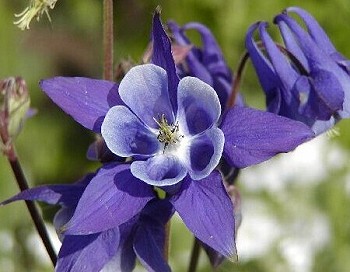
Ακουιλέγια
(Aquilegia vulgaris)
|
Aquilegia (Columbine) -
Aquilegia spp.
Aquilegia (columbine) is a genus of about 60-70 species of herbaceous perennial plants that are found in
meadows, woodlands, and at higher altitudes throughout the Northern Hemisphere.
Aquilegias, or Columbines are known for their distinctive flowers, that are produced during the
summer,
generally bell-shaped, with each petal modified into an elongated nectar spur. Its fruit takes the form of a
follicle.
Several species are grown in gardens; Aquilegia vulgaris (European Columbine) is a traditional garden flower in the British
Isles, and several of the species
like Aquilegia canadensis that are native to North America are popular garden plants
there. Numerous hybrids have also been developed as well. They are easy to propagate from
seed.
They are used as food plants by some Lepidoptera species including Cabbage Moth, Dot
Moth, The Engrailed and Mouse Moth.
It has been suggested that the name Aquilegia
comes from the Latin word "aquilinum," meaning "like an eagle."
This is due to the talon like features of the spurs. Another hypothesis ties Aquilegia
to the Latin for "water bearer" and would be attributable to the
flower's capacity to store large amounts of nectar in its petals. The name
columbine also has its origin in Latin. The word it comes from is columba
which means "dove" or columbnus, which means "like a dove."
Although the symbolism is dramatically different from that of the eagle,
columbine were thus named because of how much the inverted flower resembled a
clustering of doves.
Held in high esteem by Northern European
populations, Aquilegia vulgaris (German: Akelei, Swedish:Akileija) was dedicated to the Norse goddess of love and
fertility, Freya. According to mythology, Freya lived in a beautiful palace where love songs constantly
played. Among her magical
possessions was a coat of bird feathers that gave her the power to change into a
falcon.
Over time, Christianity adopted the symbolic associations of Aquilegia with the goddess Freya and
love. Elements of the plant’s original mythical symbolism were transferred to the Virgin
Mary. For example, a 16th century painting depicting the flight to Egypt includes a Columbine growing at the feetof Mary’s
donkey. Later Christian symbolism relates the plant’s seven blossoming flowers to the seven cardinal virtues of
Christianity: faith, hope, charity, justice, temperance, prudence and fortitude. The plants perfect geometrical composition
(according to the Golden Mean) and its number of flowers and petals (3, 5, and 7) relate it to divinity in paintings of Jesus and the Holy
Spirit.
Aquilegia is edible. The flowers are
edible raw. Rich in nectar, they are sweet and delightful, they make a very attractive addition to mixed salads and can also be used as a
thirst-quenching munch in the garden. The flowers are also used as a tea
substitute.
Columbine was formerly employed in herbal medicine mainly for its antiscorbutic
effect, but it has fallen out of favour and is little used nowadays. The leaves root and seed are
astringent, depurative, diaphoretic, diuretic, parasiticide. A homeopathic remedy is made from the
plant. It is used in the treatment of affections of the nervous system.
Some north american tribes boiled the entire plant and used the resulting liquid
as a type of shampoo or hair wash. The seeds were also rubbed into the hair to
control lice. The dried and crushed seed is used to kill external body parasites.
Source:
http://en.wikipedia.org/wiki/Aquilegia
http://www.pfaf.org/database/plants.php?Aquilegia+vulgaris
http://www.homeopathyschool.org/assets/pdf/Columbine_proving.pdf