Valentine.gr/The Greek Flowers Portal
 

flaglogo-gr.bmp (910 bytes)  

Unitedkingdom_sm.gif (528 bytes)  

 
Search WWW Search Valentine.gr

Welcome To The Greek Flowers Portal

Home   Info   Contact


Join Valentine mailing list!
Enter your email address below,
then click the 'Join List' button:


ADVERTISEMENT...


  LINK OF THE MONTH

Valentine.gr  

July 2005

Did you know that when the Spanish first saw zinnia species in Mexico, they thought the flower was so unattractive they named it mal de ojos, or "sickness of the eye"?

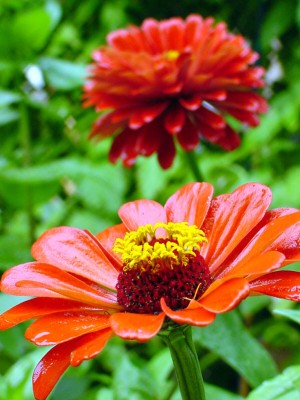
Zinnia elegans

Zinnia (Zinnia spp.)

Zinnias are cheerful, fun-looking flowers, almost like a lollipop on a stick. The straight stems are topped by a pom-pom of bright candy colours. Zinnias are native to Mexico where the Spaniards called it mal de ojos, because the flowers were small and considered ugly to the eye. First cultivated in Austria in 1613. Zinnia elegans, is the most commonly grown kind along with its many different varieties. There are both single and double flowered kinds. Zinnia form bushy, erect, self-branching plants, growing 1 to 4 feet in height. Zinnia flowers are virtually in every colour except blue, from May to October. In the language of flowers, Zinnia appropriately stands for "thoughts of absent friends".

For decades, zinnias have been the flowering annual of choice for spreading glorious colors throughout the garden as well as for cutting to bring indoors. But it wasn't always so. When the Spanish first saw zinnia species in Mexico, they thought the flower was so unattractive they named it mal de ojos, or "sickness of the eye!" 

The Marchioness of Bute was sent the seeds of the Zinnia from Mexico by Professor Casimir Gomez de Ortego. The Marchioness was wife to the British Ambassador to Madrid and daughter-in-law to John Stuart Bute who was director of the Royal Botanical Gardens at Kew. 

Even after seeds of zinnias were sent back to Europe in the 18th century, the plants were not much to look at. 

The zinnia is among the many flowers named for botanists. It commemorates Johann Gottfried Zinn (1727-1759) the German professor of botany and medical professor at Gottingen University who wrote a description of the flora around Gottingen. Zinn, wrote the first description of the flower.

ิhe genus Zinnia had to wait for the late 19th century to become more successful as a garden annual. But the start of the zinnia's real popularity began around 1920 when Bodger Seeds Ltd. introduced the dahlia-flowered 'Giant Dahlia'.

One of the reasons for the popularity of the zinnia is the diversity of its forms. Like dahlias and chrysanthemums, zinnias have a variety of flower forms and may be single, semidouble, or double. Zinnias also have an amazing number of colors; in fact, flowers come in almost every shade except blue. Most are solid, but some, in particular Z. haageana, are bicolored with a contrasting color at the tip of each petal.


Source:
http://www.flowers.org.uk/flowers/facts/s-z/zinnia.htm
http://www.bostongardens.com/bostongardens/ detail.cfm?id=2101&catid=1&webid=1

 

  LINK OF THE MONTH


Pachypodium
Physalis
Ceropegia
Sturt pea - Swainsona formosa
Clematis
Grevillea
Jade vine - Strongylodon macrobotrys
Sansevieria - Snake Plant
Trochetia
Yareta - Azorella compacta
African tulip tree - Spathodea campanulata
Angel's Trumpets - Brugmansia
Achiote - Annato - Bixa orellana
Sausage Tree - Kigelia pinnata
Castor Oil Plant - Ricinus communis
Firewheel Tree - Stenocarpus sinuatus
Bat Flower - Tacca
Snake gourd - Trichosanthes cucumerina
Sedum
Hydnora - Hydnora africana
Pickerel Weed - Pontederia
Argan - Argania spinosa
Astilbe - False Goats Beard
Feijoa - Pineapple Guava - Acca sellowiana
Aquilegia - Columbine
Cassiope
Sweet Box - Sarcococca
Christmas Cactus - Schlumbergera
Foxtail Lily - Eremurus
Rue - Ruta graveolens
Pittosporum
Ylang-Ylang - Cananga odorata
Rose of Jericho - Anastatica hierochuntica
Gunnera
Waterlily - Nymphaea
Calico Flower - Aristolochia
Daylily - Hemerocallis
Contorted hazel - Corylus avellana Contorta
Torch Ginger - Etlingera elatior
Mistletoe - Viscum album
Devil´s claw - Harpagophytum procumbens
Teasel - Dipsacus
Pampas grass - Gynerium argenteum - Cortaderia Selloanna
Purple coneflower - Echinacea purpurea
Coral Tree - Erythrina crista-galli
Portulaca
Lobelia
Field Poppy - Papaver Rhoeas
Narcissus - Daffodil
Mimosa pudica - Sensitive Plant
Boxwood - Buxus sempervirens
Firethorn - Pyracantha
Star of Bethlehem - Ornithogalum
Cosmos
Muscari - Grape Hyacinth
Papyrus - Cyperus papyrus
Zinnia
Honeysuckle - Lonicera
Passiflora - Passion Flower
Calendula - Marigold
Lupine - Lupinus
Canna - Indian Shot
Witch Hazel - Hamamelis
Oak - Quercus
Brunsvigia - Candelabra Flower
Tree peony - Paeonia suffruticosa
Olive - Olea europaea
Cornflower - Centaurea cyanus
Desert rose - Adenium obesum
Oleander - Nerium Oleander
Abutilon
Sweet Pea - Lathyrus odoratus
Chaenomeles - Flowering Quince
Forsythia
Amaryllis - Hippeastrum
Butchers broom - Ruscus aculeatus
Bay Laurel - Laurus nobilis
Gloriosa
Bamboo
Gladiolus
Artichoke - Cynara scolymus
Clivia - Clivia Miniata
Dipladenia - Dipladenia sanderii
Date palm - Phoenix dactylifera
Peach - Prunus persica
Almond - Prunus amygdalus
Willow - Salix
Pomegranate - Punica granatum
Protea cynaroides
Colchicum autumnale
Bird of Paradise - Strelitzia reginae
Cardon - Pachycereus pringlei
Wolffia arrhiza
Puya raimondii
Fuchsia
Asphodelus - Asphodel
Primula - Primerose
Dicentra spectabilis - Bleeding Heart
Edelweiss - Leontopodium alpinum
Helleborus Niger - Christmas Rose
Zantedeschia - Calla Lily
Fritillaria imperialis - Crown imperial
Aster
Heliconia
Common Sunflower - Helianthus annuus
Bee Orchid - Orphys apifera
Convalaria majalis - Lily of the Valley - Muguet
Syringa Vurgaris - Lilac
Viola
Impantiens
Snowdrop - Galanthus
Poinsettia - Euphorbia pulcherrima
Dionaea muscipula
Banksia
Sea anemone
Amorrhophallus titanum
Rafflesia arnoldi


ADVERTISEMENT...


Valentine.gr/The Greek Flowers Portal
....

Home | Information | Advertise | Contact Us | Greek Version | English Version