|
|
Bixa orellana (Achiote ,
Annato)
|
Achiote - Annato - Bixa orellana
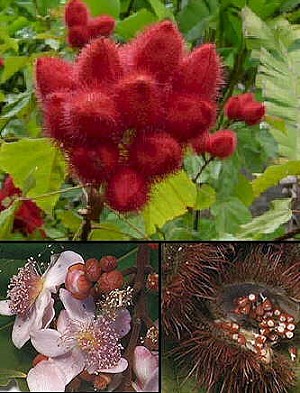
Bixa orellana L. (Achiote , Annato) is a shrub or bushy tree which ranges from 3 to 10 meters in height from the tropical region of the American continent. Its glossy, ovate leaves are evergreen with reddish veins; they have a round, heart-shaped base and a pointed tip. With a thin, long stem, the leaves are between 8 and 20 cm long and 5 and 14 cm wide. The twigs are covered with rust colored scales when young and bare when older. Bixa’s flowers are pink, white, or some combination, and are 4 to 6 cm in diameter. From the flower protrudes a striking two-valved fruit, covered either with dense soft bristles or a smooth surface. These round fruits, approximately 4 cm wide, appear in a variety of colors: scarlet, yellow, brownish-green, maroon, and most commonly bright red. When ripe, they split open and reveal a numerous amount of small, fleshy seeds, about 5 mm in diameter and covered with red-orange pulp, the embryo of which is poisonous (Chopra 1949).
Bixa orellana can be found in regions spanning the globe. Grown from either seed or cutlings, B. orellana requires full sunlight and protection from the wind (Morton 1974). The plant grows equally well in lowlands and mountainous regions or areas of higher elevation (Bruggeman 1957). Native to the tropical American area, B. orellana is found in largest quantities from Mexico to Ecuador, Brazil, and Bolivia. It is cultivated there and in Southeast Asia, where it was introduced by the Spanish in the 17th century. This plant is cultivated in warm regions of the world, such as India, Sri Lanka, and Java (Wolf 1997) mainly for the natural pigment annatto,
which the seeds yield. Bixa has been found in and about the towns of the Philippines (Quisumbing 1951), southeastern Africa (Williamson 1955), and Dominica (Honychurch 1980), and is commonly planted in Florida as an ornamental.
he name Achiote derives from the Nahuatl word for the shrub, achiotl. It is also known as Aploppas, and its original Tupi name urucu. There are a variety of common names for B. orellana because it flourishes in a variety of places. It is most frequently called “annato” or “achiote” in North America. Some of its other common names around the world are as follows: “changuarica,” “k’u-zub,” and “pumacua” (Mexico), “annato” and “urucu” (Brazil), “urucum” (Germany), “roucou” (Dominica and the French West Indies), “achiot” (Colombia), and “arnotto” (Amerindian).
The inedible fruit is harvested for its seeds, which contain annatto, also called bixin. It can be extracted by stirring the seeds in water. It is used as a red-orange dye
to color food products, such as cheeses, fish, and salad oil, butter, and soup. Sold as a paste or powder for culinary use, mainly as a color, it is known as "achiote," "annatto," "bijol," or "pimentao doce." It is a main ingredient in the Yucatecan spice mixture recado rojo, or "achiote paste." The seeds are ground and used as a subtly flavored and colorful additive in Latin American, Jamaican and Filipino cuisine. Annatto is growing in popularity as a natural alternative to synthetic food coloring compounds. While it has a distinct flavor of its own, it can be used to color and flavor rice instead of the much more expensive saffron.
. It is an important ingredient of cochinita pibil, the spicy pork dish popular in
Mexico.
The dye is also used in some regions to dye textiles (Morton 1981; Ledin 1952) and the Sionas and Secoyas color fabrics and weapons with it (Schultes & Raffauf 1990). In the Philippines, the red pulp from the seeds is used in the as polish for russet leather (Quisumbing 1951) and the seeds are ground and used as a condiment (Magness et al. 1971). Various indigenous groups paint their hair and bodies with the pulp to repel insects and protect from sunburn.
The achiote has long been used by American Indians to make body paint, especially for the lips, which is the origin of the plant's nickname, lipstick tree. The use of the dye in the hair by men of the Tsachila of Ecuador is the origin of their usual Spanish name, the Colorados. Bixin was also the original Amerindian warpaint (Mabberly 1987). The seeds are given to bulls to make them aggressive for bullfighters and are taken by indians as an aphrodisiac (Morton 1981). A fiber may be obtained from the bark (Quisumbing 1951).
Parts of the plant can be used to make medicinal remedies for such conditions as sunstroke, tonsilitis, burns, leprosy, pleurisy, apnoea, rectal discomfort, and headaches.
The sap from fruits is also used to treat type 2 diabetes, and fungal infections.
Source:
http://en.wikipedia.org/wiki/Achiote
http://www.virtualherbarium.org/gl/bixa/bixaorellana.htm