|
|
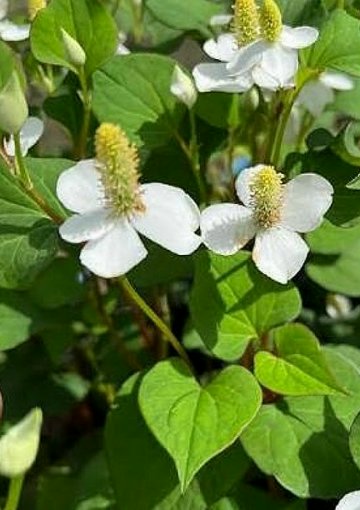
Fish Mint (Houttuynia cordata).
Flowers and leaves.
|
Fish Mint - Houttuynia cordata
Houttuynia cordata, also known as fish mint, fish leaf, rainbow plant, chameleon plant, heart leaf, fish wort, or Chinese lizard tail, is one of two species in the genus Houttuynia (the other being H. emeiensis). It is a flowering
perennial plant, in the Saururaceae (Lizard's Tail) family, native to Southeast Asia. It grows in moist, shady locations.
Houttuynia cordata is a rhizomatous herbaceous perennial plant that can grow to 0.6–1 m, spreading up to 1 m.
It spreads indefinitely and often vigorously by rhizomes. The proximal part of the stem is trailing and produces adventitious roots, while the distal part of the stem grows vertically.
The stems are green or sometimes purplish red, and either smooth or pubescent on the nodes. The lower parts of the leaf stalks form a sheath round the
stem.
Species plants feature alternate ovate to cordate dark blue-green leaves
(4–9 cm long and 3–8 cm broad) edged with red. Foliage is aromatic when bruised.
Its flowers are greenish-yellow and borne on a terminal spike 2–3 cm long with four to six large petal-like white basal bracts. It normally blooms in the summer. The stamens usually degenerate, and the fruits are apomictic, i.e. they develop seeds without being fertilized. The species is hermaphrodite (has both male and female organs).
It is native to Nepal, Taiwan, Myanmar, Bhutan, India, Indonesia, Japan, China, Thailand, Vietnam and Korea. In South
Korea.
It is considered an invasive plant because of its ability to regrow rhizomes from any segment of its foliage.
It can grow in full shade (deep woodland) or semi-shade (light woodland). It prefers moist or wet soil and can grow in water.
It is primarily grown as a ground cover in moist to wet areas, including aquatic margins.
Genus name honors Martin (or Maarten) Houttuyn (1720-1794), Dutch naturalist and physician.
Specific epithet means heart-shaped for the leaves.
Houttuynia cordata is edibe in Southeast Asia and Far East.
It is commonly grown as a leaf vegetable, and is used as a fresh herbal garnish. The leaf has an unusual taste from its volatile oil decanoyl acetaldehyde (3-oxododecanal), a taste that is often described as "fishy", earning it the nickname "fish mint".
Teder young shoots and leaves eaten raw or cooked as a pot-herb. Root
eaten cooked.
The leaves and young shoots are harvested in the spring when about 8cm long. Strongly aromatic according to one report whilst others say that it is rather smelly and somewhat like rotten fish. Our experience is that the leaves have a delicious orange-like smell and make a marvellous flavouring in salads. One report says that there are two distinct chemotypes of this species. Plants from Japan have an orange scent, whilst those from China have a smell resembling coriander leaves (Coriandrum sativum). Some people seem to really like this leaf, others are indifferent to it or strongly dislike it. It also varies quite considerably according to the time of year. In the spring and summer it has a very acceptable flavour, but by autumn a distinct bitterness has crept in.
In northeastern India, the leaves are commonly used in salads, salsas, or cooked with other vegetables, and as a garnish over side dishes. The tender roots can also be ground into chutneys along with dry meat or fish, chilies, and tamarind. It is used raw as a salad and cooked along with fish as fish curry. In Japan and Korea, the dried leaves may be used as an herbal tea.
The edible rhizome of Houttuynia cordata with a fresh, spicy, peppery flavour that is used in southwestern Chinese
cuisine.
In Vietnamese cuisine, the plant is called diếp cá and is used with grilled meat and noodle salad dishes. Fish mint may be used as a garnish with several Vietnamese dishes, such as stir-fried beef with fish mint
salad.
Houttuynia cordata was used in traditional Chinese medicine, including by Chinese scientists in an attempt to treat SARS and various other disorders, although there is no high-quality clinical research to confirm such uses are safe or effective, as of 2018. When administered via injection, H. cordata can cause severe allergic reactions.
Extracts of this plant are a major ingredient in Korean skincare products.
The whole plant is antibacterial, antiinflammatory, antimicrbial, antiphlogistic, antiviral, depurative, diuretic, emmenagogue, febrifuge, hypoglycaemic, laxative and ophthalmic. A decoction is used internally in the treatment of many ailments including cancer, coughs, dysentery, enteritis and fever. Its use is said to strengthen the immune system. Externally, it is used in the treatment of snake bites and skin disorders. The leaves and stems are harvested during the growing season and used fresh in decoctions. The leaf juice is antidote and astringent. A root extract is diuretic. The root is also said to be used in medicinal preparations for certain diseases of women. The rhizomes yield a sterol, resembling sitosterol, which stimulates the secretion of antibiotic substances from a gram-positive spore-forming bacillus. An active substance, effective in the treatment of stomach ulcers, has been extracted from the plant.
Source:
https://en.wikipedia.org/wiki/Houttuynia_cordata
https://plantfinder.mobot.org/PlantFinderDetails.aspx?kempercode=a638
https://pfaf.org/user/plant.aspx?latinname=Houttuynia+cordata
https://www.eppo.int/ACTIVITIES/plant_quarantine/alert_list_plants/
houttuynia_cordata