|
|
Trifoliate orange
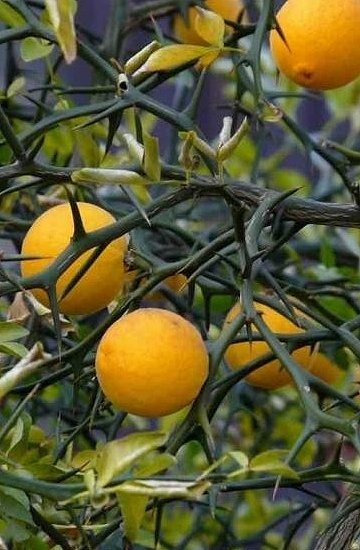
(Poncirus trifoliata). Leaves and fruits.
|
Trifoliate orange - Poncirus trifoliata
The trifoliate orange, Poncirus trifoliata (syn. Citrus trifoliata), is a member of the family Rutaceae. Whether the trifoliate oranges should be considered to belong to their own genus, Poncirus, or be included in the genus Citrus is debated. The species is unusual among citrus for having deciduous, compound leaves and pubescent (downy) fruit.
It is native to northern China and Korea, and is also known as the Japanese bitter-orange (karatachi), hardy orange or Chinese bitter orange.
The plant is a fairly cold-hardy citrus (USDA zone 6) and will tolerate moderate frost and snow, making a large shrub or small tree
2–5 m tall. Because of its relative hardiness, citrus grafted onto Poncirus trifoliata are usually hardier than when grown on their own roots.
Genus name comes from the French word poncire a kind of citron.
Specific epithet refers to the three-lobed leaves.
Poncirus trifoliata, commonly called hardy orange, a citrus relative, is a thorny, well-branched, deciduous shrub or small tree which typically grow
2–5 m tall. An attractive
fruit-bearing shrub growing at a slow rate.
The species is unusual among citrus for having deciduous, compound leaves. Three-lobed (trifoliate as per the species name) leaves emerge yellowish-green in spring, turn glossy dark green in summer and fade to yellow in autumn. Spiny, dark green stems.
The trifoliate orange is recognizable by the large 3–5 cm thorns on the shoots, and its deciduous leaves with three (or rarely, five) leaflets, typically with the middle leaflet 3–5 cm
long, and the two side leaflets 2–3 cm long. As with true citrus, the leaves give off a spicy smell when crushed.
The 4-7 petaled flowers appear singly in
spring, are white, with pink stamens, 3–5 cm in diameter, larger than those of true citrus but otherwise closely resembling them, except that the scent is much less pronounced than with true citrus.
Flowers give way to 1-2.5" diameter fruits. The fruits are green, ripening to an attractive yellow in the fall. They are 3–4 cm in diameter similar in size to a lime and resembling a small orange, but with a finely downy surface and having a fuzzy texture similar to a peach. The fruits also have distinctive smell from other citrus varieties and often contain a high concentration of seeds.
Trifoliate orange fruits are very bitter, due in part to their poncirin content. Most people consider them inedible fresh, but they can be made into marmalade. When dried and powdered, they can be used as a condiment. The fruit is also used to make a refreshing drink. The freshly picked fruit yields little juice but if stored for 2 weeks it will yield about 20% juice, which is rich in vitamin C. The fruit peel can be used as a flavouring.
The fruits of the trifoliate orange are widely used in medical traditions of East Asia as a treatment for allergic inflammation. The fruits contain a number of medically active constituents including flavonoids, coumarins, monoterpenes and alkaloids. The fruit, with the endocarp and seeds removed, is carminative, deobstruent and expectorant. It is used in the treatment of dyspepsia, constipation and abdominal distension, stuffy sensation in the chest, prolapse of the uterus, rectum and stomach. It is milder in effect than the immature fruit and is better used for removing stagnancy of food and vital energy in the spleen and stomach. The unripe fruit is antidiarrheic, antiemetic, antispasmodic, deobstruent, digestive, diuretic, laxative, stimulant, stomachic and vasoconstrictor. It is used in the treatment of dyspepsia, constipation and abdominal distension, stuffy sensation in the chest, prolapse of the uterus, rectum and stomach, shock.
The thorns are used in the treatment of toothache. The stem bark is used in the treatment of colds.
Trifoliate orange and various of its hybrids with other Citrus are widely used as citrus
rootstock (oranges, lemons etc), which are valued for their resistance to cold, the tristeza virus, and the oomycete Phytophthora parasitica (root rot).
The cultivar 'Flying Dragon' is dwarfed in size, has highly twisted, contorted stems, and has even stronger thorns than the type. It makes an excellent barrier hedge due to its density and strong curved thorns. This cultivar is an unusual plant which needs a prominent placement around the home so that the excellent ornamental features, particularly the contorted stems, can be enjoyed. As a hedge, this thorny shrub is the botanical equivalent of a barbed wire fence.
Source:
https://en.wikipedia.org/wiki/Trifoliate_orange
https://www.missouribotanicalgarden.org/PlantFinder/
PlantFinderDetails.aspx?taxonid=254173&isprofile=0&
https://pfaf.org/user/plant.aspx?LatinName=Poncirus+trifoliata