|
|
Mousetrap Tree
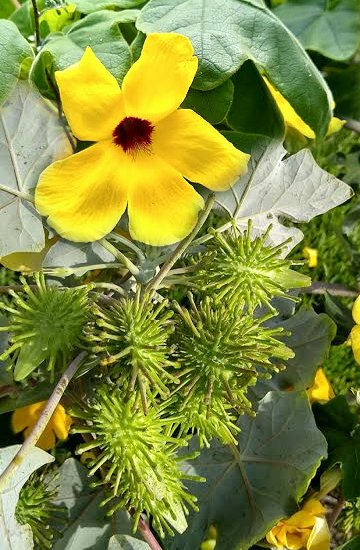
(Uncarina grandidieri).
Flowers and fruits.
|
Mousetrap Tree - Uncarina grandidieri
Uncarina is a genus of semi-succulent flowering plants in the Pedaliaceae (the sesame family) found in Madagascar.
Uncarina grandidieri, also known as mousetrap plant, mousetrap tree, succulent sesame, farehitra, or farehitsy, is a species of semi-succulent, caudex-forming flowering plants native to South
Madagascar.
The name for the genus Uncarina comes from the Latin word 'uncus' meaning "hook" or "barb" in reference to the hooked spiny fruits.
The specific epithet ( grandidieri) was given by Otto Stapf (1857-1933), an Austrian born botanist and taxonomist to honour Alfred Grandidier (1836–1921), a French naturalist and explorer in Madagascar. We have long called this plant Succulent Sesame as it is in this family, but the fruit is also responsible for the alternative common name Mousetrap Tree.
Because of habitat loss and plant collection this plant has become scarce and in 2013 it came under protection of Appendix II of the Convention on International Trade in Endangered Species of Wild Fauna and Flora (CITES).
Uncarina grandidieri is a multibranched shrub or small pachycaulescent tree that may ultimately attain a height of 3-5 meters and 80 cm girth. The stems are stout and become thickened with age.
Unlike other Uncarina species, Uncarina grandidieri has smaller leaves. The leaves
are long-stalked, three- to five-lobed, more or less sticky-hairy with blades of variable outline, up to 12.5 cm long by 15 cm broad. Those on flowering shoots are smaller than the others. The leaves resemble those of the cotton plant (genus Gossypium) and are fuzzy and are sticky to the touch, yielding a musty odour when rubbed. The leaves are deciduous during the winter resting season.
The flower resembles a large Petunia in form and is bright yellow with a dark throat, as in the "Black Eyed Susan Vine" (Thunbergia alata) and give way to green fruit covered in otherworldly
spines. In Clusters on young shoots, the flowers have a calyx of 5 sepals, and a 6 cm long corolla with a narrow tube and an oblique face of 5 wide-spreading, somewhat unequal, about 2.5 cm long, rounded, bright yellow lobes (petals). The throat of the flower is stained with purplish-red. These are four fertile stamens, one rudimentary staminode (sterile stamen), and one style.
Uncarina grandidieri has a very unique way of being pollinated. Usually, pollen is delivered to the ovule by pollen tubes that grow from the pollen grain, while this plant does not shed pollen from its anthers. Instead, it requires a pollen-eating beetle to enter the floral tube and bite into the stigma, causing a pollen-containing paste to be released onto the beetle. As the beetle moves from flower to flower pollen is transferred to the ovule of another plant, resulting in fruit development.
The fruits are flat, pointed
they are covered with small inwardly pointed spines mounted on 18 mm pedicels. Each spine has a tiny hook an the end; as the fruit dries, the remaining seed pod becomes a real hazard. Though not always developing, after flowering, the fruit that can develop is quite interesting and architecturally attractive, but is also best left alone as the small inwardly pointed barbs mounted on
8-10cm pedicels will stick to anything. Don't touch this fruit unless you want to spend some time trying to remove it from your fingers (worse than a Chinese finger puzzle!).
These seed pods work much like mechanical traps—any passing animal, clothing, or skin that brushes against them gets snagged and tightly gripped by the
barbs (hence the common name, mousetrap
tree).
All parts of plant are poisonous if ingested.
Source:
https://en.wikipedia.org/wiki/Uncarina_grandidieri
https://www.llifle.com/Encyclopedia/TREES/Family/Pedaliaceae/
15877/Uncarina_grandidieri
https://www.smgrowers.com/products/plants/plantdisplay.asp?plant_id=2479
https://onlinelibrary.wiley.com/doi/abs/10.1111/curt.12349