|
|
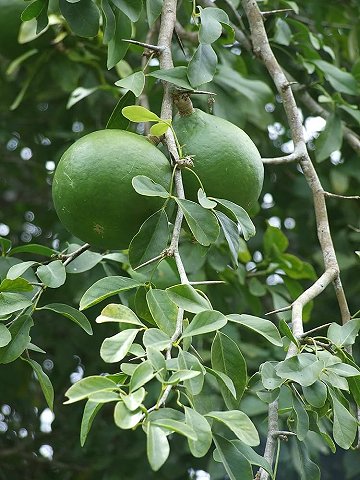
Bael (Aegle marmelos). Leaves and fruits.
|
Bael - Aegle marmelos
Aegle marmelos, commonly known as bael (a.k.a. bel, beli, or bhel), also Bengal quince, golden apple, Japanese bitter orange, stone apple or wood apple, is a species of tree native to the Indian subcontinent and Southeast Asia. It is present in India, Pakistan, Bangladesh, Sri Lanka, and Nepal as a naturalized species. The tree is considered to be sacred by Hindus and Buddhists. Bael is the only member of the monotypic genus Aegle.
Aegle marmelos botanical name originates from Greek and Portuguese, with roots in ancient Indian (Sanskrit) culture. "Aegle" is derived from Greek mythology (one of the Hesperides), while "marmelos" comes from the Portuguese word for "quince," referencing the fruit's resemblance to the European quince.
Aegle marmelos is a deciduous shrub or small to medium-sized tree, up to 13 metres tall with slender drooping branches and rather open, irregular crown.
The bole, which is usually fluted at base, can be 50cm in diameter. The tree is armed with 1 - 2cm long spines on older branches and also produces very spiny basal suckers.
The bark is pale brown or grayish, smooth or finely fissured and flaking, armed with long straight spines, 1.2–2.5 centimetres singly or in pairs, often with slimy sap oozing out from cut parts. The gum is also described as a clear, gummy sap, resembling gum arabic, which exudes from wounded branches and hangs down in long strands, becoming gradually solid. It is sweet at first taste and then irritating to the throat.
The leaf is trifoliate, alternate, each leaflet 5–14 cm x 2–6 cm, ovate with tapering or pointed tip and rounded base, untoothed or with shallow rounded teeth. Young leaves are pale green or pinkish, finely hairy while mature leaves are dark green and completely smooth. Each leaf has 4–12 pairs of side veins which are joined at the margin.
The flowers are 1.5 to 2 cm, pale green or yellowish, sweetly scented, bisexual, in short drooping unbranched clusters at the end of twigs and leaf axils. They usually appear with young leaves. The calyx is flat with 4(5) small teeth. The four or five petals of 6–8 millimetres
overlap in the bud. Many stamens have short filaments and pale brown, short style anthers. The ovary is bright green with an inconspicuous
disc.
The fruit typically has a diameter of between 5 and 10 cm (2 and 4 in). It is globose or slightly pear-shaped with a thick, hard rind and does not split upon ripening. The woody shell is smooth and green, gray until it is fully ripe when it turns yellow. Inside are 8 to 15 or 20 sections filled with aromatic orange pulp, each section with 6 (8) to 10 (15) flattened-oblong seeds each about 1 cm long, bearing woolly hairs and each enclosed in a sac of adhesive, transparent mucilage that solidifies on drying. The exact number of seeds varies in different publications.
The fruit takes about 11 months to ripen on the tree, reaching maturity in December. It can reach the size of a large grapefruit or pomelo, and some are even larger. The shell is so hard it must be cracked with a hammer or machete. The fibrous yellow pulp is aromatic. It has been described as tasting of marmalade and smelling of roses. Boning (2006) indicates that the flavor is "sweet, aromatic and pleasant, although tangy and slightly astringent in some varieties. It resembles a marmalade made, in part, with citrus and, in part, with tamarind." Numerous hairy seeds are encapsulated in a slimy mucilage.
The bael tree is is harvested in large quantities from the wild for its many uses and is traded in national
markets. Aegle marmelos is native across the Indian subcontinent and Southeast Asia, and is cultivated throughout Sri Lanka, Tamilnadu, Pakistan,
Thailand, and Malesia. Studies indicate the origin of the bael fruit in India, in the Eastern Ghats and in the central to northern parts of the country. In this country, states where the bael fruit is grown include Uttar Pradesh, states in Eastern India (Bihar, West Bengal, Madhya Pradesh, Jharkhand, and Orissa), as well as in the Himalayan foothills, the Deccan plateau and the Indo-Gangetic plains.
It occurs in dry, open forests on hills and plains at altitudes from 0–1,200 m
with mean annual rainfall of 570–2,000 mm. It has a reputation in India for being able to grow in places that other trees cannot. It copes with a wide range of soil conditions (pH range 5–10), is tolerant of waterlogging and has an unusually wide temperature tolerance from −7–48 °C. It requires a pronounced dry season to give fruit.
Rich in vitamin C, the fruits can be eaten either fresh from trees or after being dried and produced into candy, toffee, pulp powder or
nectar or made into marmalades, jams, jellies, drinks etc. The orange fruits have an aromatic, pleasant-flavoured yellow pulp. At ripening the pulp contains scented mucilage, which has a sweet flavour. The fruit may be cut in half, or the soft types broken open, and the pulp, dressed with palm sugar, eaten for breakfast. If fresh, the juice is strained and sweetened to make a drink similar to lemonade. The juice can be made into sharbat, also called bela pana.
Young leaves and shoots - cooked as a vegetable or used as a condiment. They are said to reduce the appetite.
An infusion of the flowers forms a refreshing beverage.
The leaves, bark, roots, fruits, and seeds are used in traditional medicine to treat various illnesses They contain coumarins, flavonoids, alkaloids, tannins and oil.
The dried pulp is astringent. It reduces irritation in the digestive tract and is an excellent remedy in cases of diarrhoea and dysentery. A decoction of the astringent unripe fruit, combined with fennel and ginger, is prescribed in cases of haemorrhoids. A decoction of the unripe fruit is highly valued as an aphrodisiac and has gained a reputation of being the viagra of the plant world.
The ripe fruit is also laxative and demulcent. It eases stomach pain and supports healthy function of the stomach.
It has been surmised that the psoralen in the pulp increases tolerance of sunlight and aids in the maintaining of normal skin colour. It is employed in the treatment of leucoderma.
Marmelosin derived from the pulp is given as a laxative and diuretic]. In large doses, it lowers the rate of respiration, depresses heart action and causes sleepiness.
For medicinal use, the young fruits, while still tender, are commonly sliced horizontally and sun-dried and sold in local markets. They are much exported to Malaysia and Europe. Because of the astringency, especially of the wild fruits, the unripe bael is most prized as a means of halting diarrhoea and dysentery, which are prevalent in India in the summer months.
The leaves are astringent and are used in the treatment of peptic ulcers.
A paste made from about 100g of the leaves is mixed in a cup of water and administered orally once a day for 3 days in the treatment of diabetes.
The stems are used as chewsticks.
There is as much as 9% tannin in the pulp of wild fruits, less in the cultivated types. The rind contains up to 20%, whilst it is also present in the leaves. The rind of the unripe fruit is employed in tanning and also yields a yellow dye for calico and silk fabrics.
The essential oil of the leaves contains d-limonene, 56% a-d-phellandrene, cineol, citronellal, citral; 17% p-cyrnene, 5% cumin aldehyde. The limonene-rich oil has been distilled from the rind for scenting hair oil.
A pungent essential oil obtained from the fruit rind is used in making perfumes and soap.
A leaf extract from the plant has been found to have insecticidal activity against the brown plant hopper, an important pest of rice plant in Asia
The shells of the dried fruits with the pulp removed are used as cups and small containers. They have been fashioned into ornamental pill- and snuff boxes, sometimes decorated with gold and silver.
The mucilage, or gum, around unripe seeds is used as an adhesive and household glue. The gum enveloping the seeds is most abundant in wild fruits and especially when they are unripe. It is commonly used as a household glue and is employed as an adhesive by jewellers. It is mixed with lime plaster for waterproofing wells and is added to cement when building walls. Artists add it to their watercolours, and it may be applied as a protective coating on paintings.
The gum around the seeds is sometimes resorted to as a soap-substitute. The fruit pulp has detergent action and has been used for washing clothes.
The grey-white wood is strongly aromatic when freshly cut. It is fine-grained, hard, but not durable; takes a fine polish. Generally available in smaller dimensions, it is often utilized for carving and making small objects such as small-scale turnery, tool and knife handles, pestles and combs. When larger sizes are available it has been used for carts and construction, though it is inclined to warp and crack during curing.
The wood can be used for fuel.
Source:
https://en.wikipedia.org/wiki/Aegle_marmelos
https://tropical.theferns.info/viewtropical.php?id=Aegle+marmelos