|
|
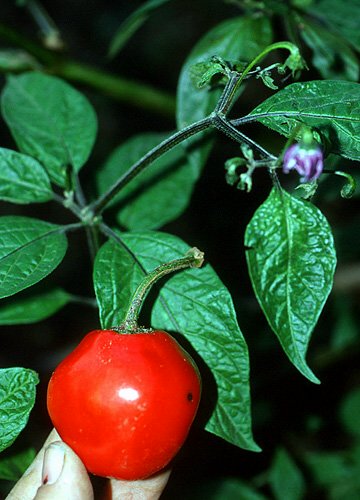
Rocoto (Capsicum pubescens).
Leaves, flowers and fruits.
|
Rocoto - Capsicum pubescens
Capsicum pubescens is a plant of the genus Capsicum (pepper). The species name, pubescens, refers to the hairy leaves of this pepper. The hairiness of the leaves, along with the black seeds, make Capsicum pubescens distinguishable from other Capsicum species. Capsicum pubescens has pungent yellow, orange, red, green or brown fruits.
This species is found primarily in Central and South America, and is known only in cultivation.
The plant is harvested mainly for local use as a food and medicine. It has long been cultivated for its edible fruits within its native range, and is now also sometimes cultivated at higher elevations in Central America and Indonesia.
It is consumed fresh, as a paste, dried, or ground. Of all the domesticated species in the genus Capsicum, it is the least widespread and most genetically distinct. It has no common name in
English although is called Tree Pepper, and its name in Spanish varies by country: it is called by the indigenous terms rocoto in Peru and Ecuador (from the Quechua rukutu or ruqutu) and locoto in Bolivia and Argentina (from the Aymara luqutu); however, in Mexico the term chile manzano (literally, "appletree pepper") is used due to the visual similarity of the fruit to apples.
Capsicum pubescens is a much-branched, erect, evergreen perennial plant.
Like all other species of the genus Capsicum, plants of the species Capsicum pubescens grow as a shrub, but sometimes as climbing plants. They grow into four-meter woody plants relatively quickly, and live up to 15 years, which gives them, especially with age, an almost tree-like appearance. After initial growth, the plant branches at a height of about 30 cm for the first time, and further growth divides into a bushy appearance. More shoots develop from the leaf axils. Some varieties have purple discoloration on the branches, as can be observed in other Capsicum species. The leaves have a 5–12 mm long petiole and a leaf blade ovate to 5–12 cm long, 2.5 to 4 cm wide, tapering at the top and the base is wedge-shaped.
The flowers appear singly or in pairs (rarely up to four) on the shoots, and the branches are at about 1 cm long flower stems, which extend on the fruit to around 4–5 cm. The calyx has five triangular pointed teeth, which have in the fruit a length of about 1 mm. A characteristic different from other cultivated species of the genus Capsicum is the blue-violet-colored petals, brighter in the centre. The anthers are partly purple, partly white.
The fruit are mostly red-fleshed, but can also be found in other colours.
Capsicum pubescens is native to Bolivia, Peru and Ecuador, dating to pre-Incan times. Traces of its presence have been found in the Guitarrero Caves. The existence of Capsicum pubescens was documented by ancient Peruvians of the Paracas, Nazca, Moche, and Chimu cultures, through textiles, ceramics, and domestic remains. Capsicum pubescens is likely to belong to the oldest domesticated plants in the Americas, its domestication dating back to 6000 BC. Capsicum pubescens is believed to have evolved from other, more primitive wild Capsicum species occurring in the same area. Of all the domesticated species of peppers, this is the least widespread and genetically furthest away from all others. It is reproductively isolated from other species of the genus Capsicum and forms a distinct genetic lineage.
In the early 1900's Capsicum pubescens was introduced to Indonesia where it is now grown along other Capsicum species. The routes of introductions remain unclear, as Capsicum pubescens is found on multiple Indonesian islands. A white flower mutant of Capsicum pubescens is widely distributed in West and Central Java, which differentiates it from the normally purple flowering plants.
Capsicum pubescens is rare outside of Central America, being found in cultivation primarily in Bolivia and Peru where it likely originated. It is commonly cultivated from Mexico to Peru, as well as in Indonesia. The plants are usually grown at small scale in courtyards and family gardens, and only surpluses reach markets.
Given its cold tolerance, Capsicum pubescens grows at higher elevations than other species, and cannot survive the tropical heat in the lowlands. However, Capsicum pubescens is not frost-tolerant and requires a long vegetation period of about 9 months. These climate requirements are the main challenges for introducing it to other locations.
The fruits of Capsicum pubescens are a versatile food in South American cuisine. The flesh is thicker than that of other chilis, closer to the consistency and size of bell peppers. The level of spice is comparable to other common known chilis, with 50,000 to 250,000 Scoville Heat Units recorded.
The distinctive thick-fleshed pungent fruits are used as a vegetable condiment or made into a sauce. A hot pungent flavour, it is mainly used as a flavouring in cooked foods. In Peru the seeds are removed, the fruit stuffed with a savoury filling and then baked. The fruit can be dried and ground into a powder for use as a pepper-like condiment.
The seeds and the white membranes, which contain most of the spice, are cut out. The prepared rocoto chilis are used for a variety of dishes. Rocoto relleno is a popular dish in Arequipa, a city in the Andes of Peru. The hollowed out and boiled rocotos are filled up with a mixture of ground beef, onions, garlic and spices. It is topped off with a piece of cheese and baked in the oven. The fruits of the Capsicum pubescens are also used as additions to other meals. Chili paste is made by mixing the chilis with oil. Chili cream is made by mixing rocoto chilis with fresh cheese. Aji de Huacatay is a green sauce which contains green rocoto chilis and is served typically with potatoes. Additionally, rocotos are used for fresh salsas.
Medicinal, The hot and pungent fruit is antihaemorrhoidal when taken in small amounts, antirheumatic, antiseptic, diaphoretic, digestive, irritant, rubefacient, sialagogue and tonic. It is taken internally in the treatment of the cold stage of fevers, debility in convalescence or old age, varicose veins, asthma and digestive problems. Externally it is used in the treatment of sprains, unbroken chilblains, neuralgia, pleurisy etc.
Source:
https://en.wikipedia.org/wiki/Capsicum_pubescens
https://tropical.theferns.info/viewtropical.php?id=Capsicum+pubescens