Valentine.gr/The Greek Flowers Portal
 

flaglogo-gr.bmp (910 bytes)  

Unitedkingdom_sm.gif (528 bytes)  

Welcome To The Greek Flowers Portal

Home   Info   Contact   E-shop


Join Valentine mailing list!
Enter your email address below,
then click the 'Join List' button:


ADVERTISEMENT...


  LINK OF THE MONTH

Valentine.gr  

February 2026

Did you know that the seeds of Abrus precatorius are much valued in native jewelry for their bright coloration and the are used as beads for rosaries and necklaces?

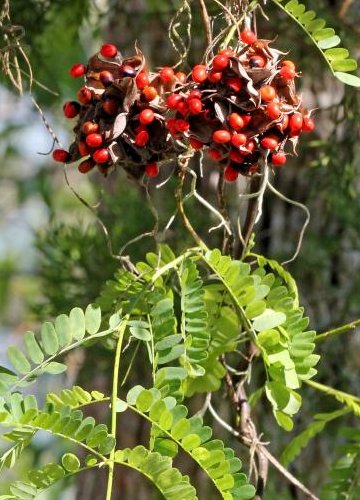
Rosary pea (Abrus precatorius). Leaves and fruits.

Rosary pea - Abrus precatorius

Abrus precatorius, commonly known as jequirity bean or rosary pea, is a herbaceous flowering plant in the bean family Fabaceae. It is a slender, perennial climber with long, pinnate-leafleted leaves that twines around trees, shrubs, and hedges.

The plant is best known for its seeds, which are used as beads and in percussion instruments, and which are toxic because of the presence of abrin. Ingestion of a single seed, well chewed, can be fatal to both adults and children. The plant is native to Asia and Australia. It has a tendency to become weedy and invasive where it has been introduced.

Abrus precatorius is a severely invasive plant in warm temperate to tropical regions, so much so that it has become effectively pantropical in distribution. It had been widely introduced by humans, and the brightly coloured and hard-shelled seeds had been spread by birds. By the end of the twentieth century, it had been proclaimed as an invasive weed in many regions including some in Belize, Caribbean Islands, Hawaii, Polynesia and parts of the mainland United States.

Abrus precatorius is a perennial, deciduous, woody, prickly twining or climbing herb producing numerous stems from the base that can be up to 6 metres, occasionally 9 metres long. These stems scramble over the ground, twining into other nearby plants for support. The deep tap root of this perennial aids in resprouting after fire or attempts at eradication.  Stem cylindrical, wrinkled, bark smooth-textured, brown.

The even-pinnately compound leaves have eight to 20 pairs of oblong 1- to 1.3-cm-long leaflets. Leaflets are turgid, oblong, obtuse, truncate at both ends, appressed hairy. They are alternate and glabrous with many paripinnate leaflets arranged in pairs.

The inflorescence is a raceme 1 to 3 cm long. The pea-like flowers are pale purple to lavenderpink or white (rarely). small, in short stalked dense clusters at leaf axils.

Fruit a short, oblong pod, 1- to 1.5-cm-wide, with a sharp beak at the tip, splitting before falling to reveal 3-8 shiny hard seeds, 6-7 mm that are scarlet red with a black spot. These attractive seeds (used to make bead necklaces and other jewelry) are extremely poisonous.

Abrin is a plant toxin obtained from Abrus precatorius seeds. Symptoms of poisoning include nausea, vomiting, convulsions, liver failure, and death, usually after several days. This plant is also poisonous to horses.

The seeds contain toxic substances, but these are easily broken down by heat. The thoroughly-cooked seeds are sometimes eaten in times of shortage, though they remain hard and are not very digestible. Temperatures in excess of 65°c are said to break down the toxic principle.

The seeds contain a number of medically active ingredients, including the extremely toxic substance abrin, indole alkaloids and anthocyanins. They are extremely toxic but are used medicinally as an abortifacient, contraceptive, emetic and irritant. The seeds are also antiperiodic, bitter, aphrodisiac, diaphoretic, emetic, expectorant and purgative. They have played an important role in the treatment of conjuctivitis in various parts of the world. The seeds, although very toxic. are applied externally as an antiseptic and anti-inflammatory poultice to accelerate the bursting of boils and to cure mastitis and galactophoritis. They are also used externally in the treatment of sciatica, hair loss, skin disease, leprosy, nervous debility and paralysis. The seeds are dried and then ground into a paste when required.

The leaves and roots contain glycyrrhizin and minute amounts of the toxin abrin. They have soothing properties and are expectorant, antiinflammatory and antiallergic. They are used internally to treat sore throats and a range of chest conditions including asthma, bronchitis and dry coughs.

The roots have been used to treat digestive disorders. A paste of the roots is applied to boils.

The stems and leaves, combined with the leaves, stems and roots of Zea mays, are made into a tisane that is used to remedy mild inflammations of the urinary tract, diarrhoea, aphthae and hoarseness. The leaves are boiled with the leaves of Tamarindus indica, Annona muricata and Lantana camara to make a syrup used to treat chest colds. A paste of the leaves is used to treat leukoderma, swellings, boils, rheumatism etc. The leaves can be dried for later use.

The stem bark is emollient. A decoction is used as a treatment for stomach-ache, thrush, colds, coughs, sore throat and asthma. An extract of the bark is used as a treatment for cancer treatment.

The seeds of Abrus precatorius are much valued in native jewelry for their bright coloration. Seeds are used as beads and to make necklaces. Popular for ornamental use and for rosaries, the necklace is traditionally given to children to wear as protection against disease. Most beans are black and red, reminiscent of a ladybug, though other colors exist. Jewelry-making with jequirity seeds is rumored to be somewhat hazardous. There are persistent reports that the workers who pierce the seeds in order to thread them can suffer poisoning or even death from a pinprick, but there seems to be little evidence.

In Trinidad in the West Indies the brightly colored seeds are strung into bracelets and worn around the wrist or ankle to ward off jumbies or evil spirits and "mal-yeux"—the evil eye. The Tamils use Abrus seeds of different colors. The red variety with black eye is the most common, but there are black, white and green varieties as well.

The seeds of Abrus precatorius are very consistent in weight, even under different moisture conditions due to the water-impermeable seed-coat. (individual seeds weigh about 1.75g or 1 carat) and are used traditionally in India to weigh gemstones. Formerly Indians used these seeds to weigh gold using a measure called a Ratti, where 8 Ratti = 1 Masha; 12 Masha = 1 Tola (11.6 Grams).

 
Source:
https://en.wikipedia.org/wiki/Abrus_precatorius
https://tropical.theferns.info/viewtropical.php?id=abrus+precatorius
https://www.fdacs.gov/Agriculture-Industry/Pests-and-Diseases/
Plant-Pests-and-Diseases/Noxious-Weeds/Abrus-precatorius-Rosary-Pea

 

  LINK OF THE MONTH


Rosary pea - Abrus precatorius
Carabao teats - Uvaria rufa
Ambarella - Spondias dulcis
Jaboticaba - Plinia cauliflora
Dao - Pacific walnut - Dracontomelon dao
Japanese Quince - Chaenomeles japonica
Calabash tree - Crescentia cujete
Peanut Butter tree - Bunchosia glandulifera
Guarana - Paullinia cupana
Golden Spoon - Nance - Byrsonima crassifolia
Pecan - Carya illinoinensis
Puya - Puya weddelliana
Allspice - Pimenta dioica
Sandalwood - Santalum album
Black Bean Tree - Castanospermum australe
West Indian locust - Hymenaea courbaril
Green birdflower - Crotalaria cunninghamii
Akar Kuning - Fibraurea tinctoria
Indian plum - Flacourtia jangomas
Apple of Sodom - Calotropis procera
Silver Vine - Actinidia polygama
Yerba Mansa - Anemopsis californica
Tree of Death - Manchineel - Hippomane mancinella
Dove Tree - Davidia involucrata
Ashwagandha - Winter Cherry - Withania somnifera
Zabala - Lardizabala biternata
Longan - Dimocarpus longan
Flame tree - Delonix regia
Ïrchid tree - Bauhinia variegata
Pink Lapacho - Handroanthus impetiginosus
African peach - Nauclea latifolia
Golden Himalayan raspberry - Rubus ellipticus
Flame Thrower Palm - Chambeyronia macrocarpa
Toothbrush tree - Mustard tree - Salvadora persica
Monastery bamboo - Thyrsostachys siamensis
Nara - Desert melon - Acanthosicyos horridus
Candelabra tree - Euphorbia ingens
Shea butter tree - Vitellaria paradoxa
Tejocote - Mexican hawthorn - Crataegus mexicana
Tree of Damocles - Oroxylum indicum
Talipot palm - Corypha umbraculifera
Albany pitcher plant - Cephalotus follicularis
Nipa palm - Nypa fruticans
Marmalade Box - Genipa americana
Ice Cream Bean - Inga edulis
Gular - Cluster fig - Ficus racemosa
Kei apple - Dovyalis caffra
Stork's Bill - Erodium cicutarium
Camu Camu - Myrciaria dubia
Pemphis - Pemphis acidula
Sisal - Agave sisalana
Jute Mallow - Corchorus olitorius
Sugar Apple - Annona squamosa
Sapodilla - Manilkara zapota
Black Sapote - Diospyros nigra
Star Apple - Chrysophyllum cainito
White Ginger Lily - Hedychium coronarium
Yuzu - Citrus junos
Wild Loquat - Sugar Plum - Uapaca kirkiana
Tonka - Cumaru - Dipteryx odorata
Chinese bayberry - Myrica rubra
Wood Apple - Limonia acidissima
Açaí - Euterpe oleracea
Tindola - Ivy gourd - Coccinia grandis
Blue honeysuckle - Haskap - Lonicera caerulea
Balata - Manilkara bidentata
Calabash nutmeg - Monodora myristica
Allanblackia
Kola nut - Cola nitida
Rainbow eucalyptus - Eucalyptus deglupta
Elephant apple - Dillenia indica
Australian Christmas tree - Nuytsia floribunda
Honeywort- Cerinthe major
Aconite - Monkshood - Wolfsbane - Aconitum napellus
Crown of Thorns - Euphorbia milii
Abyssinian banana - Ensete ventricosum
Goldenrain Tree - Koelreuteria paniculata
Naranjilla - Lulo - Solanum quitoense
Brazil nut tree - Bertholletia excelsa
Sea grape - Coccoloba uvifera
Bignay - Antidesma bunius
Cashew - Anacardium occidentale
Giant Himalayan Lily - Cardiocrinum giganteum
African Hemp - Sparrmannia africana
Lychee - Litchi chinensis
Prickly Heath - Gaultheria mucronata
Hoodia - Bushman's hat - Hoodia gordonii
Cannibals Tomato - Solanum viride
Ashoka - Saraca asoca
Ackee - Blighia sapida
African plum - Safou - Dacryodes edulis
Solandra - Solandra maxima
Stapelia - Stapelia gigantea
Foxglove - Digitalis purpurea
Swiss Cheese Plant - Monstera deliciosa
Chocolate flower - Berlandiera lyrata
Sandersonia - Sandersonia aurantiaca
Northern Japanese Magnolia - Magnolia kobus
Champak - Magnolia champaca
Hooker’s lips - Psychotria elata
Suicide Tree - Cerbera odollam
Konjac - Amorphophallus konjac
Madagascar ocotillo - Alluaudia procera
Water Banana - Typhonodorum lindleyanum
Salak - Salacca zalacca
Natal Plum - Carissa macrocarpa
Ashanti blood - Mussaenda erythrophylla
Duranta - Duranta erecta
Maqui - Aristotelia chilensis
Manuka - New Zealand Tea Tree - Leptospermum scoparium
Suriname cherry - Eugenia uniflora
Australian Finger Lime - Citrus australasica
Sacred Flower of the Incas - Cantua buxifolia
Job's tears - Coix Lacryma-jobi
Velvet Bean - Mucuna pruriens
Java Apple - Syzygium samarangense
Screwpine - Pandanus utilis
Marimo - Aegagropila linnaei
Achocha/Caigua - Inca cucumber - Cyclanthera pedata
Rubber Tree - Hevea brasiliensis
Sugar cane - Saccharum officinarum
Sacha inchi - Plukenetia volubilis
Coffea - Coffee Tree - Coffea arabica
Liquorice - Licorice - Glycyrrhiza glabra
Mullein -Verbascum thapsus
Iceplant - Mesembryanthemum crystallinum
Chayote - Sechium edule
Roselle - Hibiscus sabdariffa
Black Goji - Lycium ruthenicum Murray
Rose Cactus - Pereskia grandifolia
Durian - Durio zibethinus
Jackfruit tree - Artocarpus heterophyllus
Cassabanana - Sicana odorifera
Chilean myrtle - Arrayan - Luma apiculata
Kurrajong - Brachychiton populneus
Rice-paper Plant -Tetrapanax papyrifer
Shell Ginger - Alpinia zerumbet
Harlequin Glorybower - Clerodendrum trichotomum
Coco de Mer - Lodoicea maldivica
Silver Tree - Leucadendron argenteum
Buffaloberry - Shepherdia argentea
Himalayan Honeysuckle - Leycesteria formosa
Raisin Tree - Hovenia dulcis
Borojo - Alibertia patinoi - Borojoa patinoi
Butterfly Pea - Clitoria ternatea
Honey Flower - Melianthus major
Ombu - Phytolacca dioica
Lion's Ear - Wild Dagga - Leonotis leonurus
Moringa - Miracle Tree - Moringa oleifera
Sea Daffodil - Pancratium maritimum
Spear Lily - Gymea - Doryanthes
Camphor tree - Cinnamomum camphora
Waterwheel - Aldrovanda vesiculosa
Flowering rush - Butomus umbellatus
Four o'clock - Marvel of Peru - Mirabilis jalapa
Dead Man’s Fingers - Decaisnea
Bitter Melon - Momordica charantia
Shoapnuts Tree - Shoapberry - Sapindus
Acerola - Malpighia
Monkey Ladder - Sea Heart - Entada gigas
Cherimoya - Annona cherimola
Caper - Capparis spinosa
Lithops - Living Stones
Chaste Tree - Vitex agnus-castus
Chilean Lantern Tree - Crinodendron hookerianum
Parrot's Beak - Lotus berthelotii
Water Hyacinth - Eichhornia crassipes
Guaiac Tree - Guaiacum officinale - Lignum-vitae
Mickey Mouse bush - Ochna serrulata
Cow's Udder - Solanum mammosum
Miracle fruit - Synsepalum dulcificum
Akebia - Akebia quinata
Chilean Firebush - Embothrium coccineum
Caesalpinia - Caesalpinia pulcherrima
Welwitschia - Welwitschia mirabilis
Saguaro - Carnegiea gigantea
Schisandra - Schisandra chinensis
Monarda - Bee balm - Bergamot
Tamarind - Tamarindus indica
Neomarica - Walking Iris
Red hot poker - Kniphofia - Tritoma
Sikkim rhubarb - Rheum nobile
Reseda - Mignonette
Paulownia - Paulownia tomentosa
Belamcanda chinensis - Leopard lily
Blue Poppy - Meconopsis
Cannonball Tree - Couroupita guianensis
Tamarillo - Cyphomandra betacea
Goji - Wolfberry - Lycium barbarum
Vanilla - Vanilla Planifolia
Stevia - Stevia rebaudiana
Pachypodium
Physalis
Ceropegia
Sturt pea - Swainsona formosa
Clematis
Grevillea
Jade vine - Strongylodon macrobotrys
Sansevieria - Snake Plant
Trochetia
Yareta - Azorella compacta
African tulip tree - Spathodea campanulata
Angel's Trumpets - Brugmansia
Achiote - Annato - Bixa orellana
Sausage Tree - Kigelia pinnata
Castor Oil Plant - Ricinus communis
Firewheel Tree - Stenocarpus sinuatus
Bat Flower - Tacca
Snake gourd - Trichosanthes cucumerina
Sedum
Hydnora - Hydnora africana
Pickerel Weed - Pontederia
Argan - Argania spinosa
Astilbe - False Goats Beard
Feijoa - Pineapple Guava - Acca sellowiana
Aquilegia - Columbine
Cassiope
Sweet Box - Sarcococca
Christmas Cactus - Schlumbergera
Foxtail Lily - Eremurus
Rue - Ruta graveolens
Pittosporum
Ylang-Ylang - Cananga odorata
Rose of Jericho - Anastatica hierochuntica
Gunnera
Waterlily - Nymphaea
Calico Flower - Aristolochia
Daylily - Hemerocallis
Contorted hazel - Corylus avellana Contorta
Torch Ginger - Etlingera elatior
Mistletoe - Viscum album
Devil´s claw - Harpagophytum procumbens
Teasel - Dipsacus
Pampas grass - Gynerium argenteum - Cortaderia Selloanna
Purple coneflower - Echinacea purpurea
Coral Tree - Erythrina crista-galli
Portulaca
Lobelia
Field Poppy - Papaver Rhoeas
Narcissus - Daffodil
Mimosa pudica - Sensitive Plant
Boxwood - Buxus sempervirens
Firethorn - Pyracantha
Star of Bethlehem - Ornithogalum
Cosmos
Muscari - Grape Hyacinth
Papyrus - Cyperus papyrus
Zinnia
Honeysuckle - Lonicera
Passiflora - Passion Flower
Calendula - Marigold
Lupine - Lupinus
Canna - Indian Shot
Witch Hazel - Hamamelis
Oak - Quercus
Brunsvigia - Candelabra Flower
Tree peony - Paeonia suffruticosa
Olive - Olea europaea
Cornflower - Centaurea cyanus
Desert rose - Adenium obesum
Oleander - Nerium Oleander
Abutilon
Sweet Pea - Lathyrus odoratus
Chaenomeles - Flowering Quince
Forsythia
Amaryllis - Hippeastrum
Butchers broom - Ruscus aculeatus
Bay Laurel - Laurus nobilis
Gloriosa
Bamboo
Gladiolus
Artichoke - Cynara scolymus
Clivia - Clivia Miniata
Dipladenia - Dipladenia sanderii
Date palm - Phoenix dactylifera
Peach - Prunus persica
Almond - Prunus amygdalus
Willow - Salix
Pomegranate - Punica granatum
Protea cynaroides
Colchicum autumnale
Bird of Paradise - Strelitzia reginae
Cardon - Pachycereus pringlei
Wolffia arrhiza
Puya raimondii
Fuchsia
Asphodelus - Asphodel
Primula - Primerose
Dicentra spectabilis - Bleeding Heart
Edelweiss - Leontopodium alpinum
Helleborus Niger - Christmas Rose
Zantedeschia - Calla Lily
Fritillaria imperialis - Crown imperial
Aster
Heliconia
Common Sunflower - Helianthus annuus
Bee Orchid - Orphys apifera
Convalaria majalis - Lily of the Valley - Muguet
Syringa Vurgaris - Lilac
Viola
Impantiens
Snowdrop - Galanthus
Poinsettia - Euphorbia pulcherrima
Dionaea muscipula
Banksia
Sea anemone
Amorrhophallus titanum
Rafflesia arnoldi


ADVERTISEMENT...


Valentine.gr/The Greek Flowers Portal
....

Home | Information | Advertise | Contact Us | Greek Version | English Version